What is the purpose of the test?
The International English Language Testing System, or IELTS, is an international standardised test of English language proficiency for study, work, training, and migration purposes. IELTS has been developed by some of the world’s leading experts in language assessment, and is supported by an extensive programme of research, validation and test development.
There are two modules to choose from – Academic and General Training:
IELTS Academic is for test takers wishing to study at undergraduate or postgraduate levels, and for those seeking professional registration.
IELTS General Training is for test takers wishing to migrate to an English-speaking country (Australia, Canada, New Zealand, UK), and for those wishing to train or study at below degree level.
The IELTS test is trusted worldwide because your test is delivered according to the highest standards in security and quality. Security protocols that include identification verification of all test takers, and data encryption ensure the integrity of your test results. Similarly, you can trust in the quality and consistency of the test because all examiners are qualified highly trained and qualified. Examiners’ work is routinely monitored, and they undergo continuous training.
What is test format, and how is it scored?
IELTS test uses a nine-band scale with increments of 0.5, to assess your English language proficiency in four key skills: listening, reading, writing, and speaking. Scores range from Band Score 1 (non-user) to Band Score 9 (expert).
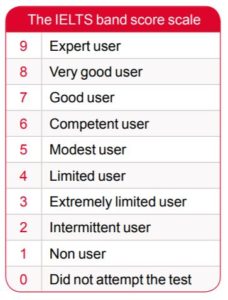
The total test time is 2 hours and 45 minutes: Listening 30 minutes, Reading 60 minutes, Writing 60 minutes, and Speaking 11-14 minutes.
For more details on the test format, including the types of task and marking scheme, see here.
Can minors take the test?
The IELTS test can be taken from the age of 16.
If you are younger than 18 years old on the day of the test, you will require permission from a parent or legal guardian in order to take the test. We must receive permission in order to capture your photograph and finger-scan on the day of the test. You will not be able to take the test unless we receive this permission. When you have made a booking, we will provide you with a consent form which you will have completed by your parent or legal guardian.
Can I request Special Requirements?
In order to ensure that the language ability of all test takers is assessed fairly and objectively, IELTS provides a comprehensive service for test takers who have special requirements, including specific learning difficulties, hearing difficulties and visual difficulties, medical conditions.
If you have a disability or special requirements we may be able to help you take your test.
If you require a modified version of IELTS, you must give the test centre three months’ notice. If your circumstances require special arrangements to be made, e.g. extra time, you must give the test centre six weeks’ notice.
Please do not hesitate to contact us to discuss your requirements. Please note that we may ask for medical evidence. CONTACT US